A commercial flat roof lifespan in New Jersey is typically 20 to 30 years. TPO and EPDM single-ply average 20–30 years, PVC 25–35, modified bitumen 15–25, built-up 20–30, and standing-seam metal 40–60. Those numbers assume proper installation, working drainage and regular maintenance. Neglected roofs routinely fail 8–12 years early, and ponding water is the single biggest reason.
Building owners usually ask about commercial flat roof lifespan for one of two reasons: they are budgeting a capital replacement, or they have just had a leak and want to know whether it is a repair or the beginning of the end. Both are good questions, and both have better answers than the manufacturer's brochure number.
The honest position is that a rated lifespan is a ceiling, not a promise. Two identical TPO roofs installed on the same day in Edison can be twelve years apart in condition by year twenty, purely because of drainage and maintenance. This guide covers what each system realistically delivers, what shortens it, and how to work out where your roof actually sits.
Commercial Flat Roof Lifespan by Membrane Type
| System | Rated lifespan | Realistic NJ average | Main limiting factor |
|---|---|---|---|
| TPO single-ply | 20 – 30 yrs | 22 – 25 yrs | Seam weld quality |
| EPDM rubber | 25 – 30 yrs | 22 – 28 yrs | Seam adhesive ageing |
| PVC single-ply | 25 – 35 yrs | 25 – 30 yrs | Plasticiser migration |
| Modified bitumen | 15 – 25 yrs | 15 – 20 yrs | UV and granule loss |
| Built-up (BUR) | 20 – 30 yrs | 20 – 25 yrs | Flashing failure |
| Standing-seam metal | 40 – 60 yrs | 40 – 50 yrs | Fastener and sealant life |
| Restoration coating | 10 – 20 yrs | 10 – 15 yrs | Recoat interval |
Note the gap between rated and realistic. That gap is not manufacturer dishonesty — it is the difference between a roof that drains properly and gets inspected twice a year, and one that nobody looks at until water appears on a desk. Roofs that receive documented maintenance consistently reach the upper end of their range.
The Six Things That Shorten a Flat Roof’s Life
1. Ponding water
By a wide margin the biggest killer. Standing water that remains more than 48 hours after rain accelerates membrane breakdown, degrades seam adhesives, grows vegetation that punctures the surface, and adds structural load — roughly 5.2 pounds per square foot for every inch of depth. A roof that ponds badly can lose a third of its expected life. We cover this in depth in our guide to ponding water on flat roofs.
2. Poor installation detail
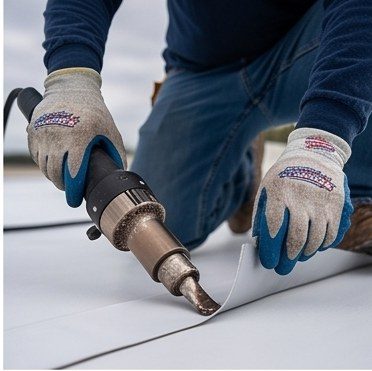
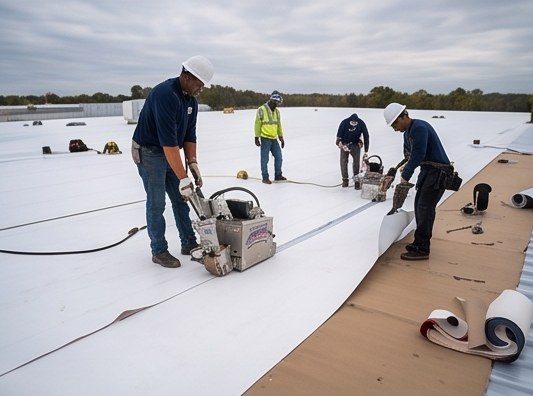
Roofs almost never fail in the field of the membrane. They fail at penetrations, curbs, drains, parapets and edges — the hand-detailed areas. A roof with excellent membrane and mediocre flashing will leak years before a roof with the reverse.
3. Foot traffic
Every HVAC service call, satellite installation and window-washing rig puts weight on the membrane. Unprotected traffic paths compress insulation and abrade the surface. Walkway pads are inexpensive and materially extend life on equipment-heavy roofs.
4. Thermal cycling
New Jersey runs from roughly 5°F to 95°F. Every cycle expands and contracts the membrane and pulls at seams and fasteners. Dark roofs cycle harder because they run hotter, which is one of the underrated arguments for reflective membranes.
5. Deferred small repairs
An open seam is a small, quick repair in year one. The same seam after three winters of water entering the insulation becomes a section replacement costing many multiples of that, because wet insulation does not dry out and never recovers its R-value.
6. Wrong membrane for the exposure
Grease from kitchen exhaust destroys TPO and EPDM. Chemical exhaust from manufacturing does the same. Where those exposures exist, only PVC survives, and specifying anything else guarantees an early failure regardless of quality.
How to Estimate the Remaining Life on Your Roof
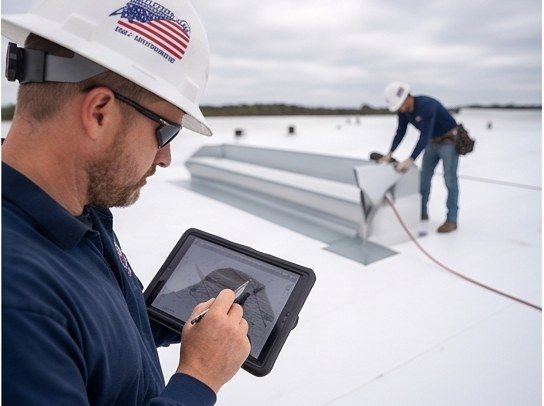
You can form a reasonable view without a contractor by checking five things. None require walking the roof if you can see it from an adjacent building or use a drone.
- Find the install date. Building records, permit history or the warranty certificate. Knowing you are at year 8 versus year 22 changes everything.
- Look for ponding 48 hours after rain. Dark rings, silt deposits and vegetation mark chronic low spots even when dry.
- Check the seams. Lifting edges, visible adhesive lines or gaps mean the roof is entering its failure phase.
- Inspect the flashings. Cracked sealant at curbs and pipe boots is normal maintenance; separated metal counterflashing is not.
- Count recent leaks. One leak is an event. Three leaks in different areas within two years is a pattern, and patterns mean systemic failure.
The definitive test is moisture scanning. Infrared or nuclear scanning maps wet insulation across the whole roof in a few hours. If less than 10% is wet, targeted repair is usually correct. Above 25%, replacement is almost always cheaper over any real ownership horizon. It is the single most useful few hundred dollars an owner can spend.
How Maintenance Changes the Numbers
The effect of a maintenance programme on commercial flat roof lifespan is larger than most owners expect, and it is well documented across the industry.
| Approach | Typical life achieved | Relative lifetime cost |
|---|---|---|
| No maintenance, reactive repairs only | 12 – 17 years | Highest |
| Occasional repairs when leaks appear | 17 – 22 years | High |
| Twice-yearly inspection + minor repairs | 25 – 30 years | Lowest |
| Inspection programme + mid-life coating | 30 – 40 years | Lowest per year |
The pattern is consistent: roofs on a documented programme last roughly 40–50% longer than neglected ones, and cost less per year of service despite the ongoing spend. Two inspections a year — spring and autumn — plus clearing drains and sealing small failures catches nearly everything while it is still cheap.
There is a warranty dimension too. Most manufacturer warranties require documented maintenance. Owners who skip it often discover at year 14 that the 20-year warranty they were relying on is unenforceable.
When a Coating Extends Life Instead of Replacing It
A roof approaching the end of its rated life is not automatically a replacement. If the membrane is dry, structurally sound and has intact seams, a silicone restoration coating can add 10 to 20 years at roughly a third of replacement cost, and it resets the warranty.
The qualifying conditions are strict and non-negotiable: moisture scanning must be clean, seams must be sound or repairable, and the substrate must be compatible. Coating over wet insulation seals the water in, and the money is wasted — the roof continues deteriorating underneath while looking new from above.
Timing matters. The right moment for a restoration coating is roughly years 15–20, while the membrane still has integrity. Wait until year 25 when seams are opening and the option has passed. Owners who plan for a mid-life coating from the beginning routinely get 35–40 years from a single membrane. See roof coatings and restoration for how we assess candidacy.
Budgeting for Replacement Before You Need It
Because flat roofs fail gradually then suddenly, the worst position is an unplanned replacement during a wet spring with tenants underneath. A simple approach avoids it.
- Establish the install year and note the rated lifespan
- Commission a condition assessment with moisture scanning at 60% of rated life
- Reassess every two years after that point
- Begin setting aside capital from year 15 on a 25-year system
- Get pricing at year 18–20 so the number in your budget is real, not estimated
Roof replacement pricing in New Jersey has risen consistently, so a figure from four years ago is optimistic. Our commercial roof replacement service page has current 2026 ranges.
Lifespan by Building Type and Exposure
Two roofs of the same membrane and same age can be in very different condition because of what the building does and where it sits. These patterns show up repeatedly across our New Jersey service area.
| Building / exposure | Effect on lifespan | Why |
|---|---|---|
| Distribution warehouse | At or above average | Low traffic, few penetrations, simple drainage |
| Light manufacturing | Reduced 3 – 6 yrs | Chemical or heat exhaust, heavy equipment, constant service traffic |
| Restaurant / food processing | Reduced 5 – 10 yrs | Grease exhaust destroys TPO and EPDM; PVC required |
| Coastal / exposed site | Reduced 2 – 5 yrs | Wind uplift fatigue, salt exposure at fasteners and metal |
| Office with rooftop HVAC | Reduced 2 – 4 yrs | Frequent service traffic, condensate discharge, many curbs |
| Cold storage | Variable | Condensation and vapour drive can wet insulation from inside |
Exposure is worth taking seriously at specification time rather than discovering later. A kitchen exhaust fan discharging onto a TPO field will produce a failure in under a decade, and no warranty covers it because the membrane was simply the wrong choice for the application.
Wind exposure deserves particular attention on taller and coastal buildings. Mechanically attached membranes flutter between fastener rows in sustained wind, and that constant movement fatigues seams. On exposed New Jersey sites, a fully adhered system typically returns its extra cost in added years.
Does Roof Age Alone Justify Replacement?
No, and this is where owners waste the most money. Age is a prompt to investigate, not a verdict. We regularly inspect 24-year-old EPDM roofs that are dry, tight and good for another five to eight years with modest repair. We also see 11-year-old TPO roofs that are finished because the seams were never welded properly.
Condition governs. A roof at year 25 with clean moisture scanning, sound seams and functioning drainage should be maintained or coated, not torn off. A roof at year 12 with 30% wet insulation and failing seams should be replaced regardless of what the warranty says. The only way to know which one you have is to look properly — which is what a professional roof inspection is for.
For technical background on service life expectations, the Whole Building Design Guide publishes durability data on commercial roofing assemblies.
Frequently Asked Questions
How long does a commercial flat roof last?
Most commercial flat roofs last 20 to 30 years. TPO and EPDM average 22 to 28 years in New Jersey, PVC 25 to 30, modified bitumen 15 to 20, and standing-seam metal 40 to 50. Regular maintenance and working drainage push roofs to the top of their range; neglect costs 8 to 12 years.
What is the average lifespan of a TPO roof?
A properly installed TPO roof lasts 20 to 30 years, averaging around 22 to 25 in New Jersey conditions. TPO lifespan depends heavily on seam welding quality, since under-welded seams are the dominant failure mode. Membrane thickness matters too — 80 mil outlasts 60 mil noticeably.
Can you extend the life of a commercial flat roof?
Yes, substantially. Twice-yearly inspections with prompt minor repairs typically add 40 to 50% to service life. A silicone restoration coating applied around years 15 to 20, while the membrane is still sound, adds another 10 to 20 years for roughly a third of replacement cost.
How do I know if my flat roof needs replacing or just repairing?
Moisture scanning is the deciding test. If under 10% of the insulation is wet and leaks are isolated, repair. If more than 25% is wet, or seams are failing across the roof, or repair costs over two years exceed about 30% of replacement cost, replace.
Does ponding water really shorten roof life?
Significantly. Water standing more than 48 hours degrades membranes and seam adhesives, supports vegetation growth that punctures the surface, and adds about 5.2 pounds per square foot per inch of depth. Chronic ponding can remove a third of a roof's expected life and voids many manufacturer warranties.
How often should a commercial flat roof be inspected?
Twice a year at minimum — spring and autumn — plus after any major storm. Roofs with heavy rooftop equipment or frequent service traffic benefit from quarterly checks. Most manufacturer warranties require documented inspections to stay valid.
Commercial Flat Roof Lifespan Across Central & North New Jersey
The guidance above applies to any low-slope commercial building, but the specifics change with local climate, code enforcement and building stock. We work on commercial and industrial buildings throughout six counties, and the housing stock, municipal permitting and weather exposure genuinely differ between them.
- Middlesex County: Edison, New Brunswick, Woodbridge, Piscataway and the distribution corridor along the Turnpike, where large simple warehouse roofs dominate.
- Somerset County: Bridgewater, Somerville, Hillsborough and Franklin Township, a mix of corporate campus and light industrial.
- Mercer County: Trenton, Princeton, Hamilton and Ewing, including a lot of older municipal and institutional building stock.
- Monmouth County: Freehold, Middletown, Red Bank and Wall, where coastal wind exposure shortens membrane life and favours fully adhered systems.
- Hunterdon County: Flemington, Clinton and Raritan Township, with more agricultural and light manufacturing structures.
- Union County: Elizabeth, Linden, Plainfield and Westfield, including heavy industrial near the port where chemical exhaust makes membrane selection critical.
If your building sits outside these counties, it is still worth asking: we regularly work beyond our core area on larger projects. See all service areas for the full list of towns we cover.
Related Guides & Services
These pages go deeper on the systems and services mentioned above:
- Commercial Roof Inspection: how a condition survey estimates the remaining life of your roof
- Roof Maintenance & Inspections NJ: twice-yearly programmes that add years to a membrane
- Roof Coatings & Restoration: the mid-life option that resets the clock for a third of replacement cost
- Commercial Roof Replacement: what happens when a roof has genuinely reached the end
- Flat & Low-Slope Roofing: complete flat-roof systems we install across Central and North NJ
- Commercial Roof Repair: targeted repairs when the roof still has life left
Need this looked at on your building? Industrial & Commercial Roofing repairs, replaces and maintains flat and low-slope roofs across Central and North New Jersey. Book a free inspection and written estimate: get in touch or call 201.397.0552.