Commercial Roof Inspection in New Jersey
Visual walks, core cuts, infrared and drone surveys for warehouses, plants, offices and retail roofs. You get a photo-documented report, a moisture map and a prioritized plan, not a guess.
Quick answer: A commercial roof inspection is a documented check of the membrane, seams, flashings, drains, edges and rooftop equipment, often backed by moisture testing. Most roofs should be inspected at least twice a year, in spring and fall, and after major storms. The result should be a written report with photos, priorities and an estimate of remaining life.
A Commercial Roof Inspection You Can Plan Around
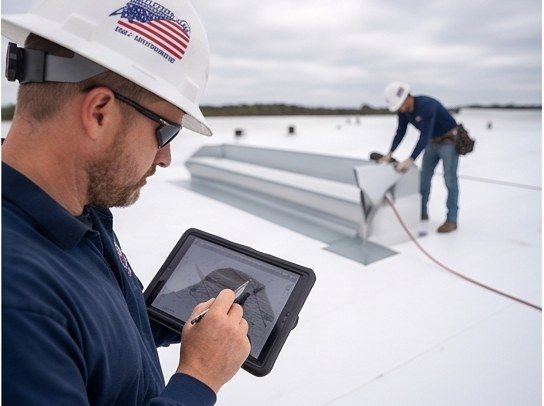
Most commercial roofs are only looked at when they leak. By then, water may have soaked insulation across a wide area, and the choice between repair and replacement has been made for you. A scheduled commercial roof inspection catches open seams, loose edge metal and blocked drains while they are still small repairs.
We inspect commercial and industrial roofs across Central and North New Jersey, from Turnpike-corridor distribution centers to older built-up roofs on downtown buildings. Inspections for prospective work are free. For owners who need a full condition survey for budgeting, a sale or a lease, we scope a paid survey around the building and what you need to decide.
- Field and seam checks
- Flashing and drain review
- Infrared moisture scans
- Drone roof imagery
- Core cuts when needed
- Written condition report
Findings You Can Act On
Hidden Moisture Found
Infrared and moisture meter surveys show wet insulation that a visual walk cannot.
Photo-Documented Report
Every issue is photographed, located on a roof plan and ranked by urgency.
Remaining-Life Estimate
You learn roughly how much service the roof has left, so you can budget ahead.
Warranty Protection
Dated inspection records support the maintenance terms in most manufacturer warranties.
How Our Roof Inspections Work
Review and Interview
We ask about leak history, roof age, past repairs and any warranty on file.
Walk and Test
We inspect the roof surface, details and interior deck, adding moisture testing where needed.
Map and Document
Findings are photographed and marked on a roof plan with a moisture map if scanned.
Report and Plan
You get prioritized repairs, a remaining-life estimate and a capital plan to work from.
Types of commercial roof inspection, and when each is used
Not every roof needs every test. A good commercial roof inspection matches the method to the question you are trying to answer, from "why is this leaking?" to "how much life does this roof have before we sign a ten-year lease?"
| Method | What it finds | When we use it |
|---|---|---|
| Visual walk | Open seams, failed flashings, punctures, loose edge metal, blocked drains | Every inspection; the starting point |
| Core cuts | Number of roof layers, insulation type and thickness, whether it is wet | To confirm moisture readings and check if a recover is possible |
| Infrared survey (ASTM C1153) | Wet insulation, shown as areas that hold heat after sunset | Large roofs, recurring leaks, repair vs replace decisions |
| Capacitance or impedance meters | Moisture in the top layers of the roof assembly, on a grid | Daytime surveys, smaller roofs, or to verify infrared findings |
| Drone imagery | Overall condition, drainage patterns, hard-to-reach areas | Very large roofs, steep or fragile sections, or roofs unsafe to walk |
Infrared surveys need the right weather. They work best on a clear evening after a sunny day, with a dry roof surface and light wind, because wet insulation releases stored heat more slowly than dry insulation. A cloudy or rainy day can make a scan useless, so we schedule them around the forecast.
Every commercial roof inspection is also a safety exercise. Skylights, unprotected edges and roof hatches are real fall hazards, so our inspectors work under OSHA fall protection rules and note any missing guardrails, skylight screens or hatch rails in the report. If the roof is unsafe to walk, a drone flight comes first.
What a commercial roof inspection checks
A thorough inspection covers the whole roof system, not just the membrane. Our checklist includes:
- Field membrane: blisters, splits, punctures, surface wear, granule loss and shrinkage.
- Seams and laps: probed on single-ply roofs, checked for open edges on mod-bit and BUR.
- Flashings: base and counterflashings at walls, curbs and expansion joints.
- Penetrations: pipes, conduits, pitch pans and supports.
- Curbs: rooftop unit, fan and hatch curbs, including corners and heights.
- Drains, scuppers and gutters: blockages, missing strainers, loose clamping rings and signs of ponding.
- Edge metal and coping: securement, open joints and sealant condition.
- Rooftop units: condensate lines, panels left off and service traffic damage.
- Skylights and fall protection: skylight seals and screens, guardrails and roof access.
- Interior deck underside: stains, rust, deflection and fastener back-out seen from inside.
What the inspection report should give you
The inspection is only as good as the document you are left with. A commercial roof inspection report from us is written for the people who have to make decisions, which may be a facility manager, an asset manager, a buyer or an insurer. It includes:
- A photo-documented condition report, with each issue located on a roof plan.
- A moisture map when infrared or meter testing is done.
- A prioritized repair list: urgent, within the year and watch items.
- A remaining-life estimate for the roof as it stands.
- A capital plan comparing repair, restoration and replacement over time.
Where the roof is still sound and dry, the plan may point toward a restoration such as silicone roof coating. Where moisture is widespread, it will show why commercial roof replacement is the better spend. Our guide to the signs a commercial roof needs replacing walks through the same red flags we look for, and our commercial flat roof lifespan guide explains how we estimate remaining life.
When to schedule a roof inspection in New Jersey
NRCA recommends inspecting low-slope roofs at least twice a year, typically in spring and fall, and after any severe weather. In New Jersey that calendar should also include these triggers:
- After a nor'easter: high wind can loosen edge metal and coping, especially on exposed and coastal Monmouth County buildings.
- After hail: bruised membrane and cracked surfacing may not leak right away.
- After heavy snow: look for deck deflection, damaged drains and crushed flashings from snow removal.
- Before and after freeze-thaw season: open seams that hold water in November can be real leaks by March.
- Before buying or leasing a building: a condition survey turns an unknown into a negotiating point.
- Before renewing insurance: carriers increasingly ask about roof age and condition.
- Before a warranty expires: defects found while the warranty is active may still be covered.
Large distribution roofs along the Turnpike corridor in Middlesex County often benefit from a drone flight first, so the walking inspection can focus on the areas that need it.
How inspections protect your manufacturer warranty
Most manufacturer roof warranties require the owner to maintain the roof and to report and repair defects promptly. Many also exclude damage caused by neglect, ponding or unauthorized rooftop work. If you ever need to make a warranty claim, dated inspection reports and repair records are your evidence that the roof was looked after.
Keep a roof file: store the warranty, the original installation details, every inspection report and every repair invoice in one place. When a claim or a sale comes up, that file is worth more than any verbal history.
Our roof maintenance programs build inspections into a regular schedule with housekeeping and minor repairs, so the documentation happens automatically. When an inspection finds active problems, we can move straight to commercial roof repair, or to flat roof repair methods matched to your membrane.
Licensing, permits and the larger-work question
Owners often ask what New Jersey requires of the roofer and the job. There is no statewide commercial roofing licence in New Jersey. Home Improvement Contractor registration with the NJ Division of Consumer Affairs applies to residential work, and some municipalities require local contractor registration. For any commercial contractor, ask for current certificates of liability and workers' compensation insurance before work starts.
Repairs found during an inspection usually do not need a permit, but larger reroofing work often does, and permits are issued by the local construction official under the Uniform Construction Code. If an inspection points toward replacing a large section, our page on the 25 percent roofing rule in New Jersey explains how bigger projects are treated.
How to prepare for a commercial roof inspection
A little preparation gets more out of the visit. Before a commercial roof inspection, gather what you have:
- The roof warranty and any original installation paperwork.
- Past inspection reports, repair invoices and leak logs.
- A floor plan with current or past leak locations marked.
- Roof access details: hatch, ladder or lift, keys and any site safety rules.
- The decision you are facing, such as a budget cycle, sale, lease or insurance renewal.
Knowing the decision behind the request lets us pick the right methods. A routine spring check needs a visual walk; a pre-purchase survey on a large warehouse may need infrared, cores and drone imagery. Either way, the commercial roof inspection report is written so you can act on it.
Professional Commercial Roof Inspection in New Jersey
For dependable commercial roof inspection across Central and North New Jersey, commercial property owners and facility managers call Industrial & Commercial Roofing. Our certified crews handle commercial roof inspection on warehouses, plants, offices, retail centers, and institutional buildings throughout Middlesex, Somerset, Mercer, Monmouth, Hunterdon, and Union Counties.
Every commercial roof inspection project starts with a free inspection and a clear, fixed-price scope, so you know exactly what you're getting with no surprises. We work to manufacturer specification, document everything, and stand behind the results. For independent commercial roofing guidance, see the National Roofing Contractors Association.
Because we install and service every major commercial roofing system, our commercial roof inspection recommendations are based on your building, not on the one product we happen to sell. That means honest advice on whether a repair, a coating, or a full replacement is the smarter investment, and crews that treat your property, tenants, and schedule with respect from the first call to the final walkthrough. We document every step with photos and reports for your records, your insurer, and your warranty.
Need commercial roof inspection for your building? Call 201.397.0552 or request a free, no-obligation estimate and we'll respond fast, including same-day dispatch for emergencies.
Standards We Work To
- NRCA: The National Roofing Contractors Association recommends regular low-slope roof inspections and sets out accepted inspection and repair practice.
- ASTM C1153: The standard practice for infrared imaging to locate wet insulation in roofing systems, which our moisture surveys follow.
- FM Global Data Sheets 1-28 and 1-29: Wind design and roof securement guidance that informs how we judge edge metal, attachment and deck condition.
- ANSI/SPRI/FM 4435/ES-1: The edge securement standard we check perimeter edge metal and coping against.
- OSHA 29 CFR 1926 Subpart M: Fall protection rules that govern how inspectors work safely on low-slope roofs and near skylights.
- NJ Uniform Construction Code: The state code under which local construction officials issue permits for roofing work found during inspection.
Systems We Install & Service
Frequently Asked Questions
How often should a commercial roof be inspected?
At least twice a year, usually in spring and fall, plus after any major storm, hail or heavy snow. Roofs with heavy rooftop equipment traffic, older membranes or a history of leaks may need quarterly checks. Many manufacturer warranties also expect regular documented inspections, so a set schedule protects your coverage.
What is the price of a roof inspection?
Our inspections are free when you are considering repair, coating or replacement work. A full condition survey for budgeting, a purchase or a lease is a paid service scoped to the roof: its size, how many roof areas there are, access, and whether infrared, core cuts or drone imagery are needed. We quote the scope before we start.
Does New Jersey require a roofing license?
New Jersey does not have a statewide commercial roofing licence. Home Improvement Contractor registration with the NJ Division of Consumer Affairs covers residential work, and some municipalities require local registration. For commercial work, always ask for current certificates of liability and workers' compensation insurance before work starts.
Do you need a permit to replace a roof in New Jersey?
Permits are issued by the local construction official under the New Jersey Uniform Construction Code. Whether one is needed depends on the scope of the work and the building, and full replacements generally require one. Ask the construction office before work starts; we handle that conversation as part of our projects.
What is an infrared roof inspection?
An infrared roof inspection uses a thermal camera, usually on a clear evening after a sunny day, to find insulation that is holding heat because it is wet. The suspect areas are marked on the roof and confirmed with core cuts or a moisture meter. It is the most efficient way to map hidden moisture on a large roof.
Should I get a roof inspection before buying a commercial building?
Yes. A condition survey tells you the roof's type, layers, moisture condition and remaining life before you commit. That turns an unknown into a number you can negotiate on, budget for or ask the seller to address. It also gives you a baseline record for future warranty or insurance questions.
What is the difference between an inspection and a maintenance program?
An inspection is a one-time assessment with a report. A maintenance program schedules inspections on a regular cycle and adds housekeeping, drain clearing and minor repairs at each visit, so issues are handled as they appear and the records build up automatically.
Do you offer a warranty?
Yes. We install to manufacturer specification so your roof qualifies for manufacturer material warranties, and we stand behind our workmanship. We register and document the warranty for your records.
Are your roof inspections and estimates free?
Yes, every project starts with a free, no-obligation roof inspection and a clear, written, fixed-price estimate.
What areas do you serve?
We serve commercial and industrial buildings across all of Central New Jersey, Middlesex, Somerset, Mercer, Monmouth, Hunterdon, and Union Counties, from our base in Edison, plus the surrounding North Jersey region.
Are you licensed and insured?
Yes. We are fully licensed and carry comprehensive liability and workers' compensation insurance. Certificates are available on request.
Book a Commercial Roof Inspection
Call 201.397.0552 or contact us to schedule a free inspection, or ask about a full condition survey with infrared and drone imaging.