The clearest signs your commercial roof needs replacing are widespread wet insulation (over 25% on a moisture scan), seams separating in multiple areas, leaks appearing in three or more separate locations, visible deck deflection or rust, and repair spending exceeding roughly 30% of replacement cost over two years. A single leak on an otherwise sound roof is a repair. A pattern across the roof is a replacement.
Every building owner wants the same thing: to spend the minimum that actually solves the problem. The difficulty is that the signs your commercial roof needs replacing look a lot like the signs it needs repairing — right up until the point where patching becomes throwing money at a roof that is already finished.
This guide separates the two. Below are nine signs your commercial roof needs replacing, roughly in order of how decisive they are, plus the single diagnostic that removes the guesswork entirely. If several of these describe your building, it is time for a proper condition assessment rather than another patch.
1. Leaks in Three or More Separate Locations
One leak is an event — a failed pipe boot, a puncture from a dropped tool, storm damage at a single flashing. Leaks appearing in genuinely separate areas of the roof within a year or two are something else. They indicate the membrane or its seams have reached the end of their service life across the whole assembly.
The test is location, not count. Five leaks all tracing back to one badly detailed curb is a repair. Three leaks at opposite corners of the building is systemic. Map where water actually enters — not where it appears inside, which can be many feet away as water travels along deck flutes.
2. More Than 25% of the Insulation Is Wet
This is the most objective indicator available, and it is why moisture scanning matters so much. Infrared or nuclear scanning maps saturated insulation across the entire roof in a few hours.
| Wet insulation | Recommended action | Reasoning |
|---|---|---|
| Under 10% | Targeted repair | Isolated failures; cut out wet areas and patch |
| 10 – 25% | Repair or partial replacement | Depends on age, location and budget horizon |
| Over 25% | Full replacement | Repair cost approaches replacement; R-value already lost |
| Over 40% | Replacement, urgently | Structural risk from load and deck corrosion |
Wet insulation does not dry out. Once polyiso is saturated it loses most of its R-value permanently, so you are paying to heat and cool the building through a roof that is no longer insulating. It also holds water directly against the deck, which is how steel decks rust through and how replacement projects turn into structural projects.
3. Seams Are Separating Across the Roof
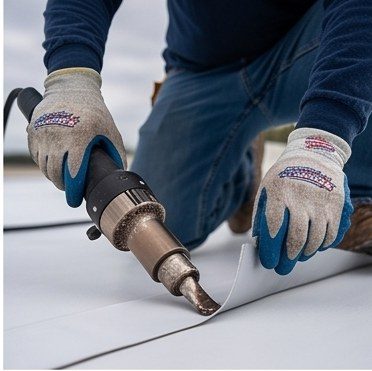
Seams are where single-ply roofs live or die. On EPDM, adhesive-bonded seams age and release — usually starting around year 15 to 20. On TPO, hot-air welded seams fail when they were under-welded at installation.
Walk the roof and look at seam edges. Slight lifting at a few isolated points is repairable. Seams opening in multiple runs, or membrane you can lift by hand at the edge, means the bond has failed generally. Re-seaming an entire roof costs a substantial fraction of replacing it, and it leaves you with an old membrane and no warranty.
4. Visible Deck Deflection or Soft Spots
Walking a roof and feeling it give underfoot is a serious finding. It means either the insulation has been crushed and saturated, or the deck itself has lost integrity. On steel decks, long-term leaks cause rust that eventually perforates. On wood decks, rot spreads well beyond the visible wet area.
Stop and get this inspected. Deck deflection is the one finding on this list with a genuine safety dimension. A compromised deck under snow load or ponded water is a structural risk, not just a roofing problem. It also changes the project — deck replacement adds significantly to cost and must be scoped before work begins.
5. Repair Spending Is Approaching Replacement Cost
Add up what you have spent on the roof in the last 24 months. If it exceeds roughly 25–30% of what replacement would cost, the economics have already turned — you are simply paying for the new roof in instalments while getting none of the benefits.
The comparison that matters is cost per year of service, not the size of the next cheque. Repeated repairs that buy a year or two at a time routinely work out more expensive per year than a replacement carrying a twenty-year warranty. The repair feels cheaper because each invoice is smaller. Run the division before deciding.
6. Chronic Ponding That Never Drains
Water that remains on the roof more than 48 hours after rain is a design or settlement problem, not a maintenance one. Ponding degrades membranes and seam adhesives, supports vegetation growth that punctures the surface, and adds about 5.2 pounds per square foot for every inch of depth.
Ponding alone does not mandate replacement — but it does mean the roof cannot be fixed by patching, because the underlying cause is slope. Correcting it requires tapered insulation or additional drains, and that work is normally done as part of a replacement. It also voids most manufacturer warranties, so a ponding roof is usually uncovered anyway.
7. The Roof Is Past 80% of Its Rated Life
Age is a prompt rather than a verdict, but it changes how you should read every other sign your commercial roof needs replacing. A leak on a year-8 TPO roof is an anomaly worth fixing. The same leak on a year-24 roof is the leading edge of general failure.
| System | Rated life | Investigate seriously from |
|---|---|---|
| TPO / EPDM single-ply | 20 – 30 yrs | Year 17 |
| PVC single-ply | 25 – 35 yrs | Year 20 |
| Modified bitumen | 15 – 25 yrs | Year 13 |
| Built-up (BUR) | 20 – 30 yrs | Year 17 |
| Standing-seam metal | 40 – 60 yrs | Year 30 |
If you do not know the install date, permit records at your municipality or the original warranty certificate will usually establish it. Knowing whether you are at year 9 or year 23 changes the entire conversation.
8. Rising Energy Bills With No Other Explanation
Saturated insulation stops insulating. When heating and cooling costs climb steadily without a change in occupancy, equipment or rates, a wet roof assembly is a common and frequently overlooked cause.
This sign rarely appears alone — by the time insulation is wet enough to move the utility bill, there are usually leaks and visible deterioration too. But it is worth noting because it quantifies part of the cost of delay. A roof with 30% wet insulation is costing money every month whether or not anything is dripping inside.
9. Flashings and Edge Metal Have Failed Generally
Roofs leak at transitions far more often than in the open field. Curbs, parapet walls, pipe penetrations, drains and edge metal are all hand-detailed, and all have finite lives.
Isolated cracked sealant at a pipe boot is routine maintenance. Counterflashing pulling away from parapets across the building, rusted-through edge metal, and failed curb flashings on most rooftop units together mean the detailing has reached end of life. Because that work is labour-intensive, replacing all of it approaches the cost of a new roof — at which point you should get a new roof and a new warranty.
New Jersey Conditions That Accelerate These Signs
Roofs in New Jersey age differently from roofs in milder climates, and several of the signs your commercial roof needs replacing show up earlier here than manufacturer literature suggests.
Freeze-thaw cycling
Central and North Jersey cross the freezing point dozens of times each winter. Water that enters a small seam opening freezes, expands roughly 9%, and widens the gap. Repeat that forty times a season and a hairline defect becomes an open seam. This is why small failures that would linger harmlessly in Virginia become urgent here.
Snow load and ice damming
Wet snow at roughly 20 pounds per cubic foot on a roof that already ponds is a real structural consideration. Ice damming at parapets and drains backs water up under flashings, driving leaks in areas that stay dry the rest of the year — which is why some buildings only leak in February.
Coastal wind exposure
Buildings in Monmouth County and along the shore see sustained wind uplift that fatigues mechanically attached membranes and works fasteners loose over time. Combined with salt exposure at metal edge details, exposed sites commonly reach end of life two to five years earlier than inland equivalents.
Energy code at replacement
One practical consequence worth planning for: when you do replace, New Jersey energy code requires bringing insulation up to roughly R-30. Buildings still carrying 1980s insulation need noticeably thicker polyiso, which raises curbs, edge metal and door thresholds. It is a genuine cost, and it is one reason a replacement quote can exceed a ballpark figure from a few years ago.
What To Do Once You Have Spotted the Signs
Recognising the signs your commercial roof needs replacing is only useful if it leads to a decision. A sensible sequence:
- Document what you are seeing. Photograph interior staining with dates, and note where and when leaks appear. Patterns over time are far more informative than a single inspection.
- Establish the roof age. Permit records, warranty certificates or building files.
- Commission a condition assessment with moisture scanning. This produces the objective data everything else rests on.
- Get the report in writing, including a wet-insulation map, photographs of each failure and a remaining-life estimate.
- Use that report as the bid specification so every contractor quotes the same scope.
- Compare on cost per year of service, not headline price, and confirm warranty type rather than just the term.
If water is actively entering the building, that sequence starts after the emergency is contained. Temporary stabilisation first, diagnosis second — see emergency roof repair for what to do in the first hour.
The Test That Settles It
If you take one thing from this guide: commission a roof condition assessment with moisture scanning before making the decision. It typically costs a small fraction of a replacement and produces objective data — a map of wet insulation, photographs of every failure point, core samples showing what is actually built up there, and a written remaining-life estimate.
That report does two things. It tells you definitively whether you are repairing or replacing, and it becomes the specification other contractors bid against — which means you get comparable quotes instead of five different scopes. Owners who skip it either replace roofs that had years left, or keep patching roofs that were finished.
For guidance on inspection standards and what a competent assessment should include, the National Roofing Contractors Association publishes industry criteria.
Frequently Asked Questions
How do I know if my commercial roof needs replacing or repairing?
Moisture scanning decides it. Under 10% wet insulation with isolated leaks means repair. Over 25% wet, seams failing in multiple areas, or repair costs above roughly 30% of replacement over two years means replacement. Age matters as context, not as the verdict.
How many leaks before a commercial roof should be replaced?
It is about location rather than count. Several leaks tracing to one detail is a repair. Three or more leaks in genuinely separate areas within a year or two indicates systemic failure of the membrane or seams, which points to replacement.
Can a commercial roof be partially replaced?
Yes. Sectional replacement works when failure is confined to one clearly defined area and the rest of the roof scans dry. It is common on large roofs and on buildings with additions of different ages. The trade-off is a seam between old and new systems and usually a limited warranty on the new section.
What does a commercial roof inspection cost?
A visual condition assessment on a typical commercial building is usually a few hundred dollars, and infrared moisture scanning adds to that depending on roof size. Against a replacement running well into six figures, it is the cheapest decision-making information available. Many contractors, including us, inspect free for building owners.
Does wet insulation have to be replaced?
Yes. Saturated polyiso does not dry out and does not recover its R-value, so it must be cut out and replaced. Leaving it in place under a new membrane traps moisture against the deck, causes corrosion, and will void a manufacturer warranty.
Will insurance pay to replace my commercial roof?
Only for sudden damage from a covered event such as wind, hail or storm. Gradual wear-out from age is treated as maintenance and is the owner’s responsibility. If a storm caused the failure, document it with photographs immediately and get an inspection before any repairs are made.
Signs Your Commercial Roof Needs Replacing Across Central & North New Jersey
The guidance above applies to any low-slope commercial building, but the specifics change with local climate, code enforcement and building stock. We work on commercial and industrial buildings throughout six counties, and the housing stock, municipal permitting and weather exposure genuinely differ between them.
- Middlesex County: Edison, New Brunswick, Woodbridge, Piscataway and the distribution corridor along the Turnpike, where large simple warehouse roofs dominate.
- Somerset County: Bridgewater, Somerville, Hillsborough and Franklin Township, a mix of corporate campus and light industrial.
- Mercer County: Trenton, Princeton, Hamilton and Ewing, including a lot of older municipal and institutional building stock.
- Monmouth County: Freehold, Middletown, Red Bank and Wall, where coastal wind exposure shortens membrane life and favours fully adhered systems.
- Hunterdon County: Flemington, Clinton and Raritan Township, with more agricultural and light manufacturing structures.
- Union County: Elizabeth, Linden, Plainfield and Westfield, including heavy industrial near the port where chemical exhaust makes membrane selection critical.
If your building sits outside these counties, it is still worth asking: we regularly work beyond our core area on larger projects. See all service areas for the full list of towns we cover.
Related Guides & Services
These pages go deeper on the systems and services mentioned above:
- Commercial Roof Inspection: infrared and visual surveys that confirm whether replacement is due
- The 25% Rule for Roofing in NJ: what actually decides repair versus replacement in New Jersey
- Roof Maintenance & Inspections NJ: condition assessments and moisture scanning
- Commercial Roof Replacement: what a full re-roof involves
- Commercial Roof Repair: when the roof still has usable life
- Roof Coatings & Restoration: the middle option between repair and replacement
- Commercial Flat Roof Lifespan: how long each membrane really lasts
- Emergency Roof Repair: 24/7 response when water is coming in now
Need this looked at on your building? Industrial & Commercial Roofing repairs, replaces and maintains flat and low-slope roofs across Central and North New Jersey. Book a free inspection and written estimate: get in touch or call 201.397.0552.