Metal Roof Restoration in New Jersey
Backed-out screws, leaking laps and rust do not always mean a new roof. We restore sound metal roofs on warehouses and industrial buildings with new fasteners, sealed seams and a protective coating.
Quick answer: Metal roof restoration is the repair and coating of an existing metal roof that is still structurally sound. It replaces failed fasteners, seals end-laps and side-laps, treats rust and finishes with an elastomeric or silicone coating, so the roof keeps working without the cost and disruption of a retrofit or full replacement.
Most Metal Roof Leaks Start Small
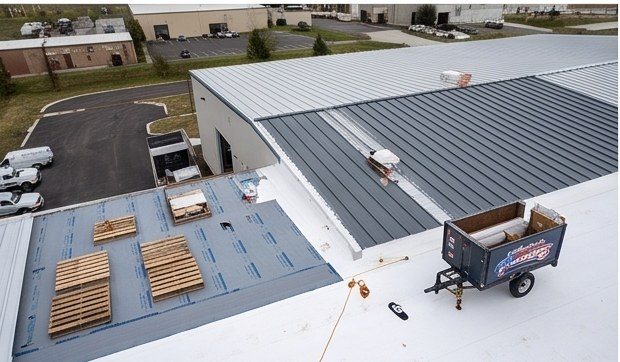
Pre-engineered metal buildings fill the industrial parks of Middlesex, Somerset and Union Counties, and their roofs tend to fail the same way: fasteners loosen, rubber washers crack, and laps open up. The panels themselves are often still in decent shape, which is why restoration makes sense on so many industrial roofs and other commercial metal roofs.
A proper metal roof restoration addresses each of those failure points in order, and it starts with a close look at the panels from both sides before any coating goes down. Done right, it stops current leaks, slows corrosion and resets the maintenance clock. Done as a quick spray-over, it hides problems that come back within a couple of seasons.
- Fastener replacement
- End-lap and side-lap sealing
- Rust treatment and primer
- Skylight panel replacement
- Elastomeric or silicone topcoat
- Written condition report
What Restoration Gets You
Fixes the Real Leak Points
New fasteners and sealed laps address the details where nearly all metal roof leaks begin.
Slows Corrosion
Rust is cleaned, primed and sealed so it stops spreading across panels and laps.
Building Stays Open
Work happens on the roof surface, so operations below usually continue without interruption.
Cooler Roof Surface
A reflective topcoat lowers panel temperatures and reduces thermal movement in the summer.
Our Metal Roof Restoration Process
Inspect Top and Bottom
We check panels, laps and fasteners from above and purlins and panel undersides from inside.
Fasten and Seal
We replace failed screws, reinforce laps and seal penetrations, ridge and trim details.
Treat Rust and Prime
Corroded areas are cleaned and primed with a rust-inhibitive primer suited to the metal.
Topcoat and Report
We apply the specified coating thickness and hand you photos and a written summary.
The Metal Roof Restoration Sequence We Follow
On a typical exposed-fastener roof, the order of work matters as much as the materials. Coating over loose screws or open laps only delays the next leak. This is the sequence we use on pre-engineered metal buildings.
1. Fasteners
Daily heating and cooling makes panels expand and contract, which slowly works screws loose and enlarges their holes. UV also hardens and cracks the rubber washers. We tighten sound fasteners, and where a screw spins or the washer has failed, we replace it with a new screw and sealing washer, going up a size where the original hole has worn oversize.
2. End-laps and side-laps
Laps are where panels overlap, and they are the second most common leak source. We clean them, add sealant where the original sealant has failed, and cover them with butyl-backed seam tape or polyester fabric embedded in coating.
3. Rust treatment
Red rust on steel gets mechanically cleaned to remove loose scale, then primed with a rust-inhibitive primer. White rust on galvanized or zinc-aluminum coated panels is a different problem: it is usually cleaned and treated with a primer compatible with that finish rather than ground off. Chalky factory paint finishes are washed and adhesion-tested.
4. Topcoat
The final layer, chosen from the same roof coating systems we use on flat roofs, is an elastomeric acrylic or a silicone coating applied to a specified dry-mil thickness. Silicone is often chosen for low-slope metal where water lingers at laps; our silicone roof coating page covers that choice in detail.
Why Metal Roof Restoration Suits NJ Industrial Buildings
New Jersey weather is hard on exposed-fastener roofs. Summer sun can push panel temperatures far above the air temperature, and winter nights pull them well below freezing, so every year adds hundreds of expansion and contraction cycles that work on fasteners and lap sealant. Nor'easters then drive rain sideways into any lap that has opened.
- Monmouth County and the shore: salt air speeds corrosion at cut edges, laps and fasteners, so we look harder at panel thickness and use corrosion-resistant fasteners.
- Turnpike and Route 287 industrial parks: large pre-engineered buildings from the same era tend to show the same fastener and lap failures across the whole roof, which makes a planned metal roof restoration more efficient than chasing individual leaks.
- Older manufacturing plants: process exhaust and roof-mounted equipment can create localized corrosion that needs panel replacement before the rest of the roof is coated.
Restoration, Retrofit or Replacement
Metal roof restoration only works on metal that still has enough life in it. Before we recommend it, we look at three things.
| Condition | Usually points to |
|---|---|
| Surface rust, loose fasteners, leaking laps, panels still solid | Metal roof restoration |
| Scattered perforations or a few badly rusted panels | Restoration with individual panel replacement |
| Widespread thinning or perforation across the field of the roof | Retrofit or replacement |
| Corroded or deflected purlins, or a deck that cannot carry added weight | Structural review before any roof work |
| Need for more insulation or better drainage | Retrofit framing over the existing roof |
Retrofit framing is the main alternative. Light-gauge framing is fastened through the existing roof to the structure, insulation is added, and a new metal or single-ply roof goes on top, leaving the old panels in place. It costs more than restoration but solves insulation and slope problems a coating cannot. When the roof is past saving, our commercial roof replacement team handles tear-off and new installation.
Check from inside too. Purlin rust, condensation staining and daylight through fastener holes are often easier to see from below. We inspect both sides before we write a scope.
Skylights, Translucent Panels and Ridge Vents
Translucent fiberglass panels yellow, turn brittle and crack with age. A coating cannot fix them and should not cover them. We replace worn panels with new ones matched to the rib profile and seal their laps like any other panel.
Skylights and translucent panels are also a fall hazard. OSHA treats them as openings that need guarding during roof work, so we use screens or other protection, and we recommend permanent skylight screens for buildings where maintenance crews go up often.
Ridge vents and roof ventilators need to stay open. We seal their flashing and fasteners, mask the vent openings, and never coat across them. Trapping moisture in a metal building leads to condensation and rust from the inside.
Uplift Ratings and Manufacturer Systems
Metal roof assemblies are often tested for wind uplift under UL 580 and UL 1897. Those listings belong to a specific combination of panel, gauge, clip or fastener type and spacing, not to the coating on top. A coating does not add uplift resistance.
- Replacement fasteners should match or exceed the original type and spacing, so the attachment the listing relied on stays in place.
- If your insurer or FM Global requires an approved assembly, confirm with them before work starts; we can check the coating system on FM Approvals RoofNav.
- Use one manufacturer's complete system (primer, seam material and topcoat) so the components are tested together and the manufacturer warranty can be issued.
- Any metal roof restoration on a building insured with FM Global should be reviewed against the relevant FM data sheets, such as 1-28 for wind design, before materials are ordered.
- On standing seam roofs with floating clips, the panels must keep moving, so we seal ends and penetrations without fastening through the seams.
Rooftop Equipment and Solar
HVAC curbs, exhaust fans, pipe supports and gutters are frequent leak points on metal roofs, so their flashing gets the same reinforcement as laps. Active leaks around equipment can be handled first as a commercial roof repair. If equipment is due for replacement soon, it is far easier to swap it before the coating than after.
Solar is a common question on large Middlesex and Somerset roofs. Schedule the metal roof restoration before panels go on, because removing and reinstalling an array to reach the roof later is disruptive. On standing seam roofs, solar is often mounted with clamps that grip the seams without penetrating them. Your solar installer and roofing contractor should coordinate attachment details so neither warranty is put at risk.
Keeping a Restored Metal Roof Working
Even a thorough metal roof restoration needs regular attention afterward. We suggest an inspection at least once a year and after major storms, with gutters and drains cleared, any backed-out fasteners tightened and damaged coating touched up. Most coating warranties expect that maintenance to be documented, and our roof maintenance programs keep those records for you.
Patching between restorations
If a leak shows up between inspections, the fix should be compatible with the coating already on the roof. That means cleaning the area, using the same manufacturer's seam tape or fabric and coating, and keeping hardware-store sealants off the roof. A mismatched patch can stop a leak today and block the next recoat.
Expect fasteners in high-movement areas, like near the eaves and around equipment, to need occasional attention even after restoration. When the coating reaches the end of its warranty term, a cleaning and recoat usually renews it.
Professional Metal Roof Restoration in New Jersey
For dependable metal roof restoration across Central and North New Jersey, commercial property owners and facility managers call Industrial & Commercial Roofing. Our certified crews handle metal roof restoration on warehouses, plants, offices, retail centers, and institutional buildings throughout Middlesex, Somerset, Mercer, Monmouth, Hunterdon, and Union Counties.
Every metal roof restoration project starts with a free inspection and a clear, fixed-price scope, so you know exactly what you're getting with no surprises. We work to manufacturer specification, document everything, and stand behind the results. For independent commercial roofing guidance, see the National Roofing Contractors Association.
Because we install and service every major commercial roofing system, our metal roof restoration recommendations are based on your building, not on the one product we happen to sell. That means honest advice on whether a repair, a coating, or a full replacement is the smarter investment, and crews that treat your property, tenants, and schedule with respect from the first call to the final walkthrough. We document every step with photos and reports for your records, your insurer, and your warranty.
Need metal roof restoration for your building? Call 201.397.0552 or request a free, no-obligation estimate and we'll respond fast, including same-day dispatch for emergencies.
Standards We Work To
- UL 580: A wind uplift test for roof assemblies; replacement fasteners should preserve the attachment the original listing relied on.
- UL 1897: An uplift test for roof systems that helps confirm a metal roof assembly's wind resistance.
- FM Approvals RoofNav: Where your insurer can confirm whether a coating system or assembly carries an FM approval.
- ASTM D6083: The specification for acrylic roof coatings, one of the topcoat options on metal.
- ASTM D6694: The specification for silicone roof coatings, the other common metal roof topcoat.
- OSHA 29 CFR 1926 Subpart M: Fall protection rules that cover roof edges and skylight openings during work.
- NJ Uniform Construction Code: Your local construction official decides permit requirements, including under the Rehabilitation Subcode.
Systems We Install & Service
Frequently Asked Questions
What do you patch a metal roof with?
For small holes, clean and prime the metal, then cover the hole with butyl-backed seam tape or polyester fabric embedded in a compatible coating. Larger holes need a metal patch fastened and sealed, or a panel replacement. Avoid hardware-store silicone caulk and asphalt cement on metal you may coat later, because most coatings will not stick over them.
How often do you have to redo a metal roof?
A sound metal roof rarely needs replacement on a short cycle. What needs regular attention is the details: fasteners, washers and lap sealant. A restoration coating is typically renewed with a cleaning and recoat when its warranty term ends, while an annual inspection catches loose fasteners and damaged areas in between.
What is the 25 rule in roofing?
It refers to a building code provision, found in some code editions, that may require the whole roof to meet current code when more than a quarter of it is replaced within a twelve-month period. How it applies in New Jersey depends on the Rehabilitation Subcode and your construction official. Our guide to the 25 percent rule in NJ explains the details.
Is coating a metal roof worth it?
On a roof with solid panels and leaks at fasteners and laps, yes, as long as the prep comes first: fasteners replaced, laps sealed and rust treated. A coating alone over loose screws and open laps tends to fail early. On a roof with widespread perforations, the money is better spent on retrofit or replacement.
Can you restore a metal roof with skylights?
Yes. Aged translucent panels are usually replaced rather than coated, and their laps are sealed like the rest of the roof. Skylight openings are guarded during the work, and we recommend permanent screens on buildings where people go up on the roof regularly.
Does restoring a metal roof stop condensation inside?
Not by itself. Interior condensation comes from warm, humid air meeting a cold roof deck, so it is mostly an insulation and ventilation issue. A reflective coating helps in summer, but if dripping condensation is the main complaint, retrofit insulation or improved ventilation is usually the answer. We check for this during the commercial roof inspection.
Do you offer a warranty?
Yes. We install to manufacturer specification so your roof qualifies for manufacturer material warranties, and we stand behind our workmanship. We register and document the warranty for your records.
Are your roof inspections and estimates free?
Yes, every project starts with a free, no-obligation roof inspection and a clear, written, fixed-price estimate.
What areas do you serve?
We serve commercial and industrial buildings across all of Central New Jersey, Middlesex, Somerset, Mercer, Monmouth, Hunterdon, and Union Counties, from our base in Edison, plus the surrounding North Jersey region.
Are you licensed and insured?
Yes. We are fully licensed and carry comprehensive liability and workers' compensation insurance. Certificates are available on request.
See If Your Metal Roof Can Be Restored
Get a free top-and-bottom inspection and a written, fixed-scope proposal for restoration, retrofit or replacement, whichever fits your building.