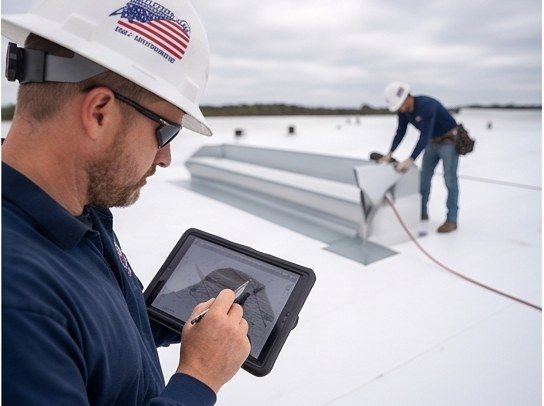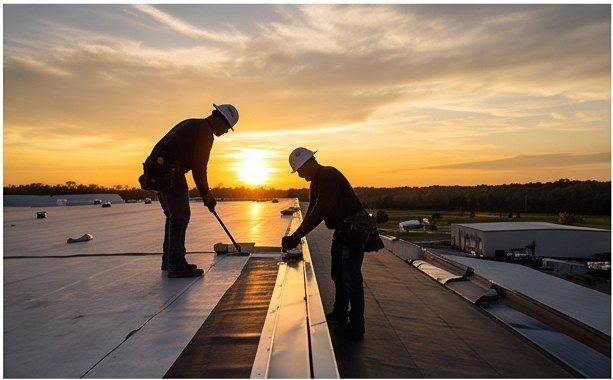
Effective commercial roof leak repair starts with finding the actual entry point, which is often 10 to 50 feet from where water appears inside. Water travels along deck flutes and insulation joints before dropping. Most leaks originate at details — flashings, curbs, drains, pipe penetrations and seams — not in the open membrane. An isolated detail repair is a modest job; costs rise sharply once water has been entering long enough that wet insulation has to be cut out and replaced.
A leak is the only roofing problem that announces itself, which makes it both the most urgent and the most misunderstood. Owners reasonably assume the hole is above the stain. It usually is not, and that single fact explains why so much commercial roof leak repair fails — the patch goes in the wrong place and the leak returns with the next storm.
This guide covers how water actually moves through a roof assembly, how leaks are traced properly, what the common sources are in order of frequency, realistic New Jersey costs, and what separates a repair that holds from one that buys you three weeks.
Why the Leak Is Not Where You Think It Is
On a steel-deck commercial building, water entering the membrane lands on the deck and runs along the flutes — the raised channels in the steel. It travels until it finds a seam, a fastener hole or a deck joint, then drops through. That can be fifty feet from the entry point, and it will often be at a different elevation entirely.
Insulation makes this worse. Water spreads horizontally between insulation boards, following joints across large areas before finding a path down. On a roof with tapered insulation the water follows the slope, which may run opposite to the direction you would guess from inside.
The practical consequence: patching the membrane directly above a ceiling stain is guesswork. Sometimes it works. More often it wastes the repair and confirms nothing, because the real opening is still there.
What this means for you: be sceptical of any contractor who arrives, glances at the ceiling stain, goes up and patches the corresponding spot without tracing. That is not commercial roof leak repair — it is a guess with an invoice attached.
How Professionals Actually Trace a Leak
Proper leak tracing works from the inside out and from most-likely to least-likely causes.
- Document the interior. Exact location, when it leaks (every rain? only wind-driven rain? only after snow melt?), and how quickly it starts. Timing is diagnostic — a leak that only appears during driving rain from the north-west points to a wall or parapet detail, not a field puncture.
- Identify the deck type and direction. On steel deck, flute direction tells you which way water travels, which narrows the search zone enormously.
- Inspect all details uphill of the interior location. Curbs, pipe boots, drains, scuppers, parapet flashings, equipment supports — in that order, because that is roughly their failure frequency.
- Check seams under tension, especially at corners and changes in plane where movement concentrates.
- Use moisture scanning if visual inspection is inconclusive. Infrared reveals wet insulation, and the wet area usually surrounds the entry point.
- Water-test if necessary. Flood-testing sections in sequence, starting downhill and working up, isolates the source definitively.
That process takes time — often two to four hours on a large roof. A contractor who quotes leak repair over the phone without seeing the roof is quoting a patch, not a repair.
The Most Common Sources, In Order
| Rank | Source | Share of leaks | Typical fix |
|---|---|---|---|
| 1 | Flashings at curbs and walls | ~30% | Re-flash, new termination bar and sealant |
| 2 | Pipe penetrations and boots | ~20% | New boot, target patch and reseal |
| 3 | Seams | ~18% | Re-weld or re-seam affected run |
| 4 | Drains and scuppers | ~12% | New clamping ring, lead flashing, reseal |
| 5 | Punctures and mechanical damage | ~10% | Membrane patch |
| 6 | Edge metal and copings | ~7% | Reseal or replace metal |
| 7 | Open field membrane | ~3% | Patch — rare on a roof under 15 years |
Roughly 90% of commercial roof leaks come from details rather than the field. That is why detail quality at installation matters more than which membrane brand was specified, and why an experienced repair crew goes straight to penetrations.
What Commercial Roof Leak Repair Costs in New Jersey
| Repair type | Relative scale | Notes |
|---|---|---|
| Emergency temporary stabilisation | Small | After-hours call-out, tarping or sealing |
| Single pipe boot replacement | Small | The most common small repair |
| Curb or wall re-flashing | Small to moderate | Depends on length and access |
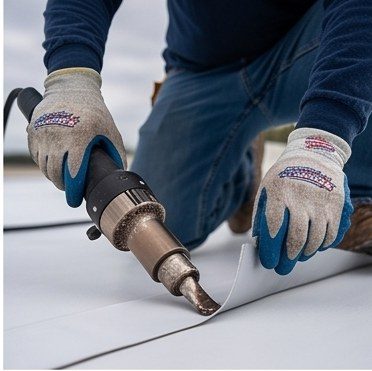
| Seam repair (per run) | Small to moderate | TPO requires hot-air welding |
| Drain reseal and clamping ring | Small | Often overlooked as a leak source |
| Section replacement with wet insulation removal | Large | Priced by area once saturation has spread |
| Leak investigation with moisture scan | Small | Often credited against the repair |
The jump between a detail repair and a section replacement is where most owners are caught out. A modest flashing repair becomes a major section replacement once water has been entering long enough to saturate the surrounding insulation, because wet polyiso must be cut out — it never dries or recovers its R-value. Time is genuinely the cost driver here, and the difference between acting in week one and week fifty is measured in orders of magnitude.
Emergency vs Permanent Repair
These are two different jobs and should be priced and understood separately.
An emergency repair stops water entering the building right now. It might be a tarp, mastic and fabric, or a temporary membrane patch. It is not expected to last, and it should not be sold as a permanent fix. Its purpose is protecting inventory, equipment and interior finishes while a proper repair is planned.
A permanent repair happens in dry conditions, addresses the actual cause, removes any wet insulation, and restores the detail to manufacturer specification so the warranty stays intact. Doing this properly usually means waiting for suitable weather, which is exactly why the emergency step exists.
If water is coming in now, see emergency roof repair — we run 24/7 response across Central and North New Jersey. Then schedule the permanent work once the building is secure.
Why the Same Leak Keeps Coming Back
Recurring leaks almost always trace to one of five causes:
- The wrong spot was patched. The original entry point was never found, so the leak was never fixed.
- Wet insulation was left in place. The membrane above is sealed but saturated insulation continues releasing water for months, mimicking an active leak.
- The underlying cause was not addressed. Patching a seam that failed because of ponding fixes the symptom; the water still sits there and the next seam goes.
- Incompatible materials. Asphalt-based mastic on a TPO membrane, for instance, degrades the membrane and fails within a season. Repairs must match the system.
- Building movement. Some details fail repeatedly because the structure moves. These need a detail redesigned for movement, not another patch.
If you have paid for the same leak three times, stop buying patches and commission a proper investigation with moisture scanning. It costs less than the fourth repair.
Repairs and Your Warranty
This catches owners out regularly. Most manufacturer warranties require that repairs be performed by an approved contractor using compatible materials. A well-intentioned maintenance person sealing a seam with hardware-store caulk can void a twenty-year NDL warranty.
Before authorising any repair on a roof still under warranty, check three things: whether the contractor is approved by that manufacturer, whether the materials are system-compatible, and whether the manufacturer needs notification. Keep documentation of every repair — warranty claims are routinely denied for want of maintenance records.
It is also worth knowing that many leaks on warrantied roofs are covered. Owners frequently pay out of pocket for repairs the manufacturer would have funded, simply because nobody checked.
Preventing the Next One
Leak repair is reactive by nature, but the frequency is controllable. Roofs on a documented maintenance programme experience dramatically fewer leaks, because the failures that cause them are caught while they are still cheap.
- Inspect twice yearly — spring and autumn — plus after major storms
- Clear drains, scuppers and gutters every season; blocked drainage causes ponding, and ponding causes seam failure
- Reseal pipe boots and curb flashings on schedule rather than on failure
- Install walkway pads on traffic routes to rooftop equipment
- Require any trade working on the roof to notify you before cutting the membrane
- Keep a written log of every repair, inspection and photograph
A roof maintenance programme typically costs a fraction of a single emergency call-out per year and materially reduces how often you need one.
When Repair Stops Making Sense
There is a point where continued commercial roof leak repair is worse value than replacement. The indicators are consistent: leaks in three or more separate areas, more than 25% of insulation wet on a moisture scan, seams failing generally rather than locally, or two years of repair spending exceeding roughly 30% of replacement cost.
The decision should be made on cost per year of service rather than on the size of the next cheque. Our guides to the signs a roof needs replacing and commercial roof replacement work through that maths in detail. For repair standards and material compatibility guidance, the NRCA publishes technical criteria.
Frequently Asked Questions
Why does my roof leak in a different place than the damage?
Water entering a commercial roof lands on the deck and travels along steel flutes or between insulation boards before finding a path down. It commonly emerges 10 to 50 feet from the entry point, sometimes at a different elevation. This is why tracing, rather than patching above the stain, is essential.
How much does commercial roof leak repair cost in New Jersey?
It depends entirely on which detail has failed and how long water has been entering. An isolated pipe boot or flashing repair is a modest job. Once water has saturated the surrounding insulation, the work becomes a section replacement priced by area, which is why delay is the main cost driver. Any reputable contractor will inspect before quoting.
Can a commercial roof be repaired in the rain?
Only temporarily. Emergency measures such as tarping or mastic can stop water entering during a storm, but permanent repairs need dry, reasonably warm conditions for adhesives and welds to bond correctly. A repair made on a wet substrate will fail.
How long should a commercial roof repair last?
A properly executed repair on a roof with remaining service life should last for the rest of that roof\u2019s life. If repairs are failing within a year or two, either the actual source was never found, wet insulation was left in place, or the roof has reached the point where replacement is the correct answer.
Will a roof repair void my warranty?
It can. Most manufacturer warranties require an approved contractor and compatible materials. Sealing a TPO seam with asphalt-based mastic, for example, both fails quickly and voids coverage. Always check warranty terms and keep documentation of every repair.
How do I find a roof leak myself?
Note exactly when it leaks — steady rain, wind-driven rain, or snow melt — as timing points to different causes. Then inspect roof details uphill of the interior location: curbs, pipe boots, drains and parapet flashings, in that order. If nothing is obvious, the leak needs moisture scanning rather than more looking.
Commercial Roof Leak Repair Across Central & North New Jersey
The guidance above applies to any low-slope commercial building, but the specifics change with local climate, code enforcement and building stock. We work on commercial and industrial buildings throughout six counties, and the housing stock, municipal permitting and weather exposure genuinely differ between them.
- Middlesex County: Edison, New Brunswick, Woodbridge, Piscataway and the distribution corridor along the Turnpike, where large simple warehouse roofs dominate.
- Somerset County: Bridgewater, Somerville, Hillsborough and Franklin Township, a mix of corporate campus and light industrial.
- Mercer County: Trenton, Princeton, Hamilton and Ewing, including a lot of older municipal and institutional building stock.
- Monmouth County: Freehold, Middletown, Red Bank and Wall, where coastal wind exposure shortens membrane life and favours fully adhered systems.
- Hunterdon County: Flemington, Clinton and Raritan Township, with more agricultural and light manufacturing structures.
- Union County: Elizabeth, Linden, Plainfield and Westfield, including heavy industrial near the port where chemical exhaust makes membrane selection critical.
If your building sits outside these counties, it is still worth asking: we regularly work beyond our core area on larger projects. See all service areas for the full list of towns we cover.
Related Guides & Services
These pages go deeper on the systems and services mentioned above:
- Flat Roof Repair: membrane-by-membrane repair methods for commercial flat roofs
- Commercial Roof Repair NJ: our repair service, response times and coverage
- Emergency Roof Repair: 24/7 response when water is entering now
- Roof Maintenance & Inspections: the programme that prevents most leaks
- Flat & Low-Slope Roofing: systems, detailing and drainage
- Commercial Flat Roof Lifespan: how long your membrane should last
- Commercial Roofing: everything we do for NJ commercial buildings
Need this looked at on your building? Industrial & Commercial Roofing repairs, replaces and maintains flat and low-slope roofs across Central and North New Jersey. Book a free inspection and written estimate: get in touch or call 201.397.0552.