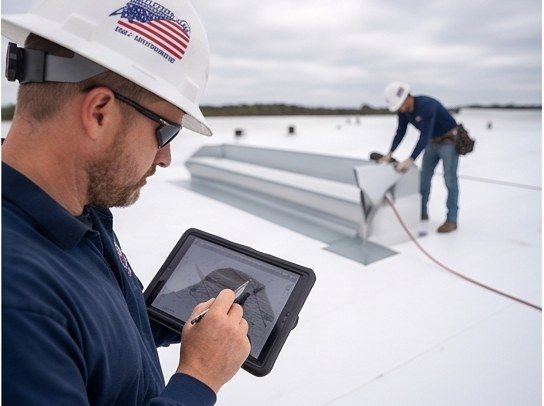
Lasting TPO roof repair means cleaning and preparing the membrane, hot-air welding a TPO patch with rounded corners, then probing the weld. EPDM roof repair uses a different method: clean, prime, apply a peel-and-stick EPDM cover tape or patch, roll it down and seal the edges with lap sealant. Both need manufacturer-compatible materials. Consumer sprays and caulks are not proper repairs for either.
TPO and EPDM cover a large share of the flat roofs on New Jersey warehouses, plants, offices and retail buildings. Both are single-ply membranes, both can be repaired well, and both are repaired badly every day, usually because someone used the wrong method or the wrong product for the membrane in front of them.
This guide covers how to tell which membrane you have, what typically fails on each one, the correct TPO roof repair and EPDM roof repair methods, why matched materials matter for your warranty, and how to decide between repair, restoration and replacement.
First, Identify Your Membrane: TPO, EPDM or PVC
Repair methods are not interchangeable, so the first job is knowing what is on the roof. Building records or the original warranty will usually tell you. If they are missing, these clues help:
| Clue | TPO | EPDM | PVC |
|---|---|---|---|
| Typical color | White, sometimes tan or grey | Black, occasionally white-on-black | White or light grey, sometimes colors |
| Seams | Heat welded, often with a thin bead of melted membrane at the edge | Taped or glued laps, with sealant at the seam edges | Heat welded, similar to TPO |
| Feel | Smooth, firm, plastic-like sheet | Soft, rubbery and stretchy | Smooth and slightly more pliable than TPO |
| Seam probe | A blunt probe slides along a solid welded seam | A probe can find voids where tape or adhesive has released | Welded seam, probes like TPO |
TPO and PVC can look almost identical from a ladder. They are both heat welded, but they are different chemistries and are not welded to each other, so a contractor should confirm which one it is (records, a sample, or experience) before cutting in a patch. If you have PVC, our PVC roofing page covers that system. For a side-by-side of the two most common membranes, see TPO vs EPDM roofing.
Common Problems With TPO Roofing
- Seam failures from poor welds. A weld made too cold, too fast or on a dirty surface can look fine and still lack a full bond. These seams open under thermal movement or wind and are a leading cause of TPO leaks.
- Weathered, oxidized surface. After time in the sun, the top of a TPO sheet oxidizes. A new patch will not weld properly to it without cleaning and surface preparation, which is why quick patches on older TPO often peel.
- Shrinkage at perimeters. Some older TPO sheets shrink over time, pulling at walls, curbs and edges and stressing the flashings.
- Punctures. Foot traffic, dropped tools and HVAC service work cause cuts and holes, especially around rooftop units.
- Flashing and penetration failures. Pipe boots, curbs, drains and wall terminations are where most leaks start on any membrane.
More background on the system itself is on our TPO roofing page.
Common Problems With EPDM Roofing
- Seam tape or adhesive release. EPDM seams rely on tape or adhesive. Age, poor priming, or installation in cold or damp conditions can let a lap release, often starting at a corner or T-joint.
- Shrinkage pulling flashings. As EPDM ages it can shrink, tenting at walls and curbs and pulling flashings away from their terminations.
- Punctures. Rubber membranes are tough but not puncture-proof. Traffic, debris and equipment work cause holes.
- Brittleness at end of life. Very old EPDM can lose flexibility and crack, particularly at folds and flashings. At that stage, patches tend to chase cracks rather than fix the roof.
- Flashing and penetration failures. As with TPO, details fail before the open field does.
Our EPDM roofing page explains the system and its installation methods in more detail.
How TPO Roof Repair Should Be Done
- Find and assess the damage. Confirm the extent, check for wet insulation underneath, and probe nearby seams.
- Clean the area. Remove dirt and debris, then clean the membrane with the manufacturer's recommended cleaner.
- Prepare weathered membrane. On older TPO, use the manufacturer's weathered-membrane preparation so the patch can fuse to the sheet rather than to an oxidized surface layer.
- Cut a TPO patch with rounded corners. Rounded corners resist peeling. The patch should extend well beyond the damage, following the manufacturer's minimum lap.
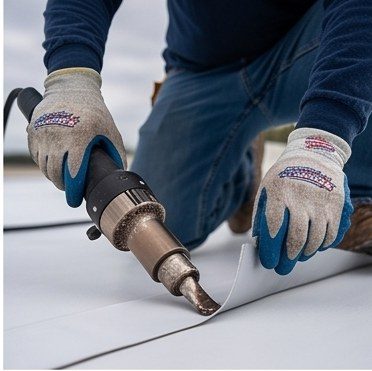
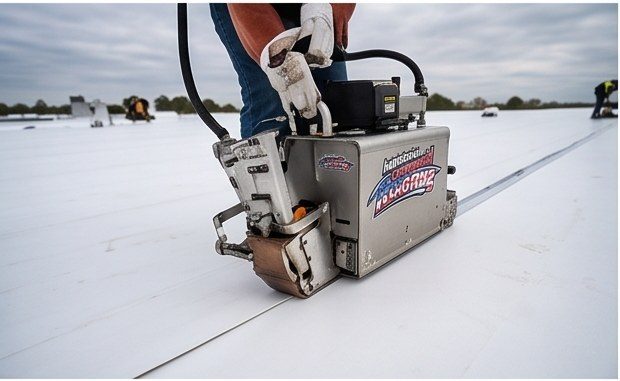
- Hot-air weld the patch. Use a hand welder and silicone roller, with test welds first to set the heat for the day's conditions.
- Probe the weld. Run a seam probe around the full perimeter to find any unbonded spots and re-weld them.
Where the problem is a seam rather than a hole, the TPO roof repair is usually to clean, prepare and re-weld the seam, or to weld a cover strip over it. Caulk or tape is not a substitute for a weld on TPO.
How EPDM Roof Repair Should Be Done
- Find and assess the damage, including any wet insulation and nearby seams that have started to release.
- Clean the membrane to remove dirt and chalky oxidation, using the manufacturer's cleaner or primer system.
- Prime the area with the primer specified for the tape or patch, and let it flash off as the data sheet directs.
- Apply a peel-and-stick EPDM cover tape or patch with rounded corners, extending beyond the damage.
- Roll it down firmly with a silicone roller, working out air and ensuring full contact.
- Seal the edges with lap sealant where the manufacturer calls for it, especially at exposed patch edges and seam intersections.
For released seams, the repair is to clean and prime both sides and install new seam tape or a cover strip, not to squeeze sealant into the gap. Sealant alone sits on top of a dirty, unbonded lap and lets go again.
Problem by Problem: TPO Fix vs EPDM Fix
| Problem | TPO fix | EPDM fix |
|---|---|---|
| Small puncture or cut | Clean, prep, hot-air weld a rounded TPO patch, probe the weld | Clean, prime, apply peel-and-stick patch, roll, lap sealant at edges |
| Open or weak seam | Clean, prep and re-weld, or weld a cover strip over the seam | Clean and prime, install new seam tape or a cover strip, roll and seal |
| Weathered or chalky surface | Weathered-membrane prep before any welding | Thorough cleaning and priming before taping |
| Shrinkage at walls and curbs | Release tension, add membrane or flashing as needed, re-terminate | Same approach: relieve the pull, add flashing, re-terminate |
| Failed pipe boot or curb flashing | New TPO boot or flashing, welded in | New EPDM boot or flashing, primed and taped |
| Widespread brittleness or failure | Evaluate restoration or replacement | Evaluate restoration or replacement |
Why Manufacturer-Matched Materials Matter
Single-ply repairs work because the patch bonds chemically or thermally to the sheet. That only happens with compatible materials: TPO to TPO, EPDM primer and tape to EPDM. Asphalt-based mastics, general-purpose caulks and consumer rubberized sprays do not bond the same way, and some can contaminate the surface around a leak so that a proper repair later needs more cleaning or a larger patch.
There is also the warranty. Most manufacturer warranties require compatible materials, and many require an approved contractor for repairs. Before anyone works on a roof still under warranty, check the terms, and keep a record of every repair. If you need help now, our commercial roof repair team works on both membranes.
Repair, Restore or Replace?
TPO roof repair or EPDM repair is the right call when the damage is local, the insulation underneath is dry, and the rest of the membrane is still flexible and well bonded. Restoration with a coating, such as silicone roof coating, can make sense when the membrane is aging evenly but the roof is still largely dry. Replacement becomes the answer when insulation is wet over large areas, seams are failing across the roof, or the membrane has become brittle.
The deciding information comes from the roof itself. A commercial roof inspection with infrared moisture scanning shows how much of the insulation is wet, which is the single most useful fact for this decision. For general low-slope repair guidance, see our page on flat roof repair.
New Jersey Timing: Cold Weather and Summer Heat
New Jersey weather affects how EPDM and TPO roof repair work is scheduled. EPDM primers, tapes and adhesives have minimum application temperatures and need a dry surface, so winter repairs may have to wait for a suitable window, or be done as a temporary measure and completed later. Frost and dew on the membrane are just as much of a problem as the air temperature.
TPO welding can be done across a wider range of temperatures, but the welder settings must change with conditions. In summer, a white membrane in full sun and a cold morning surface weld very differently, which is why test welds are made at the start of each session and whenever conditions change. If water is coming in and the weather will not cooperate, emergency roof repair can stabilize the roof until a permanent repair can be made.
Frequently Asked Questions
What are the common problems with TPO roofing?
The most common TPO problems are seams that fail because of poor welds, weathered surfaces that will not take a new weld without preparation, shrinkage at perimeters on some older sheets, punctures from foot traffic and HVAC service, and leaks at flashings and penetrations such as pipe boots, curbs and drains.
What can I use to seal a TPO roof?
A lasting TPO repair is a TPO patch hot-air welded to cleaned and prepared membrane, not a sealant. Manufacturers make TPO-compatible accessories and sealants for specific details, but general caulks, asphalt mastics and consumer sprays are not a proper TPO roof repair and can affect your warranty.
What is the average lifespan of a TPO roof?
Lifespan depends on membrane thickness, installation quality, exposure and maintenance. Many well-installed, maintained TPO roofs last around twenty years or more, while poorly welded or neglected roofs can fail much sooner. Our guide to commercial flat roof lifespan covers the factors in detail.
Can an EPDM roof be repaired?
Yes. Punctures, released seams and failed flashings on EPDM can be repaired with compatible primers, peel-and-stick tapes, patches and lap sealant. Repair stops making sense when the membrane has become brittle across the roof or insulation is wet over large areas.
How do I patch a damaged EPDM roof?
Clean the area, apply the primer specified for the patch, let it flash off, then apply a peel-and-stick EPDM patch with rounded corners that extends beyond the damage. Roll it firmly and seal the edges with lap sealant where the manufacturer calls for it. Work only on a dry surface within the product's temperature limits.
What sealant sticks to EPDM rubber?
EPDM lap sealants and primers made for EPDM membranes, used as part of the manufacturer's repair system. Sealant is meant to protect the edges of a properly primed and taped patch or seam, not to bond a repair on its own.
Does Flex Seal work on EPDM?
Consumer rubberized sprays are not compatible repair materials for single-ply membranes such as EPDM or TPO. They may slow a leak briefly, but they can complicate a proper repair later, because the area has to be cleaned or cut out before a compatible patch will bond, and they can put a manufacturer warranty at risk.
TPO and EPDM Roof Repair Across Central & North New Jersey
Across New Jersey, freeze-thaw cycles and winter dew limit when EPDM tapes and primers can be applied properly, while summer heat on large white TPO roofs along the Turnpike corridor changes how patches must be welded. We work on commercial and industrial buildings throughout six counties, and the housing stock, municipal permitting and weather exposure genuinely differ between them.
- Middlesex County: Edison, New Brunswick, Woodbridge, Piscataway and the distribution corridor along the Turnpike, where large simple warehouse roofs dominate.
- Somerset County: Bridgewater, Somerville, Hillsborough and Franklin Township, a mix of corporate campus and light industrial.
- Mercer County: Trenton, Princeton, Hamilton and Ewing, including a lot of older municipal and institutional building stock.
- Monmouth County: Freehold, Middletown, Red Bank and Wall, where coastal wind exposure shortens membrane life and favours fully adhered systems.
- Hunterdon County: Flemington, Clinton and Raritan Township, with more agricultural and light manufacturing structures.
- Union County: Elizabeth, Linden, Plainfield and Westfield, including heavy industrial near the port where chemical exhaust makes membrane selection critical.
If your building sits outside these counties, it is still worth asking: we regularly work beyond our core area on larger projects. See all service areas for the full list of towns we cover.
Related Guides & Services
These pages go deeper on the systems and services mentioned above:
- TPO Roofing: how TPO systems are installed and maintained
- EPDM Roofing: rubber roofing systems for commercial buildings
- TPO vs EPDM Roofing: how the two membranes compare
- Commercial Roof Repair: repairs matched to your membrane
- Commercial Roof Inspection: infrared moisture scanning and condition reports
- Emergency Roof Repair: when water is entering the building now
Need this looked at on your building? Industrial & Commercial Roofing repairs, replaces and maintains flat and low-slope roofs across Central and North New Jersey. Book a free inspection and written estimate: get in touch or call 201.397.0552.